

How Salmon and Steelhead Spawn
The Anadromous Life Cycle: Born in Freshwater, Built for the Ocean
 Many times on our guided Alaska salmon fishing trips, we get asked questions about the lifecycle of salmon. Salmon (derived from the Latin term salmo, which means “leaper”) have one of the most interesting life cycles of any animal on earth. Born in a freshwater stream, they migrate into the ocean to live in salt water for years, traveling thousands of miles before returning to their natal stream to spawn. This behavior is called anadromous.
While other fish are also anadromous, salmon are particularly special for several reasons:
Keystone Species: They play a vital role in their ecosystems. When they spawn and die, their carcasses transfer massive amounts of marine-derived nutrients from the ocean back into the land, supporting everything from insects and songbirds to bears and towering trees.
Physiological Mastery: Very few fish can survive such extreme shifts in salinity. Salmon undergo “smoltification,” a complex set of physiological and morphological changes in their gills and kidneys that allow them to transition between fresh and salt water environments—a process that would be fatal to most other fish.
Navigational Prowess: Salmon possess a legendary “homing instinct.” They can detect chemicals at a scale of one part per million, allowing them to smell their way back to the exact stream where they were born, sometimes navigating across thousands of miles of open ocean to do so.
Extreme Transformations: As they prepare to spawn and stop eating, their bodies undergo dramatic changes. In many species, silver scales are replaced by brilliant colors, and males often develop humps or hooked snouts (kypes).
As your Kenai Sockeye Salmon trips guide, we love sharing the wonders of these incredible fish with our guests.
Catadromous vs. Anadromous Fish: What’s the Difference?
Some fish are catadromous (opposite of anadromous). This means that they are born in salt water and migrate up rivers to feed as part of their life cycle. A classic example of this type fish would be the American eels common to North American Rivers. Eels and lamprey will often attach themselves to the sides of migrating salmon and trout to “hitchhike” a ride up river.
Pacific Salmon Species Found in Alaska Waters
There are several types of salmon in the world, and five of these are specific to the North American continent and might be seen when you are . These are the king salmon, silver, sockeye, chum and pink salmon (ordered largest to smallest).
Which Salmon Die After Spawning — and Which Ones Don’t?
All pacific salmon die after spawning. Atlantic salmon may survive spawning and return to the ocean to continue growth and spawn a second or third time. One Pacific salmonid can survive an anadromous life in the ocean to spawn more than once, and that is the steelhead, or rainbow trout indigenous to the North American continent. The life cycle of the steelhead is nearly identical to that of the Atlantic salmon. Cutthroat trout, brown trout, dolly varden and several other species of trout and char are also capable of surviving an anadromous spawning journey.
How Do Salmon Find Their Way Back to the Same Stream?
Pacific salmon are unique in that spawning is the last act of their life cycle. One of the most remarkable things about salmon is how they manage to find their natal stream after spending years in the ocean migrating for thousands of miles. Some studies have indicated that smell is a factor that enables a salmon to hone into the stream it was born in. Other studies indicate that the brain of the salmon is sensitive to the magnetic field of the earth and that this may be a factor in the homing instinct. Regardless of the mechanism that enables a salmon to do this, their ability to find the origin of their birth after migrating thousands of miles from home is truly a remarkable feat.
Why Do Salmon Change Shape and Color When They Spawn?
Salmon undergo a physical transformation during their transition from the saltwater environment back to the freshwater home of their birth. This transition affects the appearance of the fish very radically. Not only do they stop feeding, but they also undergo a color and shape change.
The Kype: Why Male Salmon Develop Curved Jaws and Teeth
The male salmon typically forms a curved mouth (called a kype) with large canine like teeth. The males of some species form a hump on their back during their transition. The female salmon do not undergo such a radical shape change, but do undergo significant color changes.
Why Salmon Strike Lures During the Spawning Migration
During the spawning migration up river, the male of the species takes the role of protector and attempts to gain the favor of a suitable female. To the fisherman, this means that the male fish are more likely to be aggressive and strike a lure or bait that intrudes his territory. Females will also strike lures and baits, and we can only presume that this is due to a similar protective trait, or an instinct to continue feeding.
The Salmon Spawning Process Step by Step
Once a dominant male and female fish have paired up for mating, the female begins to clean a well-oxygenated gravel bed by scouring it with her tail in sweeping motions.
How Female Salmon Build a Spawning Redd
The female will select an area in the streambed that has an upwelling of water through the gravel. A spawning redd can be approximately 2 to 10 feet long and 1 to 6 feet wide, depending on the size of the fish.
How Male Salmon Protect the Spawning Site
While the female is preparing the spawning bed, called a redd, the male protects the area by swimming around the activity of the female and aggressively biting at anything that intrudes, including smaller male fish. Often, spawning takes place in rather shallow water, making the fish easy prey for predators such as birds, bears, racoons, man, and other animals.
” It should be noted that by the time fish are ready to spawn, their eating quality has severely degraded. Salmon flesh that was once red, is now be white and mushy. In every state, it is illegal to disturb spawning fish. The best eating fish are those fresh out of salt water and not the fish that are ready to propagate the species.
How Salmon Eggs Are Fertilized and Covered
Once the first redd is finished, the male and female align themselves next to one another for the actual spawning ritual. Their bodies quivering next to one another, the female releases her eggs at the same time that the male releases milt. Fertilization occurs in the water as the eggs drift down into the gravel.
After the eggs have settled, the female swims upstream and sweeps the river bottom with her tail to cover the nest of eggs with clean gravel. The female will then proceed to dig another redd at a nearby location and the male will accompany her to protect the area.
What Happens If the Dominant Male Is Lost to a Predator?
In the event that the male of the pair is the victim of a predator, another male fish may undertake the task of fertilizing the eggs that the female will deposit into the spawning beds. The larger male usually dominates, however sometimes several small male fish may fertilize the eggs from a large female. This tendency probably allows for genetic diversity among the species.
Salmon Egg Hatching: Timeline and the Journey to the Ocean
The eggs will hatch in 30 to 90 days or more, depending on water temperature. Some types of salmon will migrate to the ocean in a matter of weeks after hatching from their gravel birthplace. Others may stay in the freshwater environment of the river for 1 to 2 years before migrating to the ocean.
Do Salmon Always Return to Their Natal Stream?
Although it is assumed that each salmon will return to its natal stream to spawn, this is not entirely true. Salmon do stray from one steam into another watershed. Perhaps this is nature’s way of assuring diversity in the genetic structure of these fish and that rivers affected by geologic disasters will be repopulated with the salmon that are adaptable to the environment. With our current understanding of these marvelous fish, we can only continue to guess at the mystery of the salmon life cycle.
Watch Alaska Salmon & Steelhead Spawning with Your Own Eyes
Want to see salmon spawning in Alaska for yourself? Check out our video “Eggs in October”
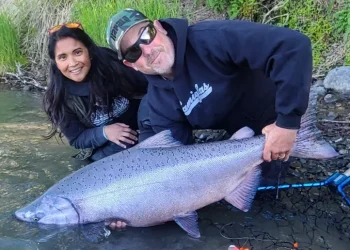
Mark and Cindy Glassmaker have been married for 28 years, and their business, Alaska Fishing with Mark Glassmaker, has been operating since 1990. Over the past 34 years guiding on the Kenai River, we’ve witnessed many changes. Through early diversification and the dedication of our entire guide staff and team, we’ve built and maintained what we believe is the premier Kenai River fishing experience.
We take great pride in our work and in the reputation our business stands for. Your trip becomes part of that legacy, and we are committed to making it exceptional. Every outing is approached with 100% effort and service, ensuring that your Alaska fishing trips not only meets but exceeds expectations.